 Sheetsmith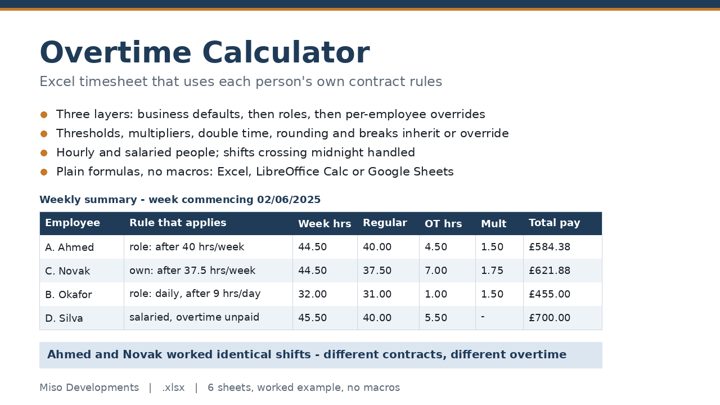
How overtime is calculated
Overtime is the time you work beyond a threshold your employer or contract sets. There are two common thresholds and many workplaces use both. A daily threshold means anything over, say, eight hours in a single shift is overtime, however short the week. A weekly threshold means anything over forty hours in the week is overtime, however the hours were spread. When both apply, the usual convention — and the one this calculator uses — is that daily overtime is taken first, and only the remaining regular hours are compared with the weekly limit, so the same hour is never counted as overtime twice.
The multiplier is what those hours pay. "Time and a half" is 1.5 times your normal rate; "double time" is twice it. Some contracts pay 1.25 for the first few overtime hours and more after that; if yours does, run the calculator once per band.
Unpaid breaks and shifts over midnight
Unpaid breaks are deducted from the shift before anything else is worked out, which is how most payroll systems treat them. A shift that finishes at 06:00 after starting at 22:00 is treated as crossing midnight and counts as eight hours, not minus sixteen. Rounding to the nearest quarter hour is on by default because most timesheets are kept that way; turn it off if you are paid to the minute.
UK notes
There is no legal right to overtime pay in the UK unless your contract provides for it, but your average pay for the total hours you work must not fall below the National Minimum Wage. Working time regulations cap the average working week at 48 hours over a 17-week reference period unless you have opted out in writing. Overtime is usually only counted towards holiday pay when it is regular enough to be considered "normal pay". None of this is legal advice; check your contract and, if in doubt, ACAS.
Questions
Is daily or weekly overtime applied first?
Daily first. Only the remaining regular hours are compared with the weekly threshold, so no hour is counted as overtime twice.
Does it handle night shifts that cross midnight?
Yes — a finish time earlier than the start time is treated as the next day.
Is overtime pay a legal right in the UK?
Not unless your contract says so, but your average pay for all hours worked must stay above the National Minimum Wage.